
Since December 2021, Retrieve have been working with NHS England South West, the West of England and SW Peninsula Integrated Stroke Networks and South Western Ambulance Service NHS Foundation Trust to improve the timeliness and care provided en-route for patients requiring transfer for mechanical thrombectomy.
Transfer process
Patients requiring transfer between hospitals to receive MT are time critical. The majority (around 85%) are low risk and require a time critical 999 SWASFT ambulance with a paramedic. Most patients receive IV rtPA which takes approximately 1 hour to deliver via infusion and, if this is to continue and complete during the transfer, these patients require an appropriately trained nurse escort from the acute stroke centre.
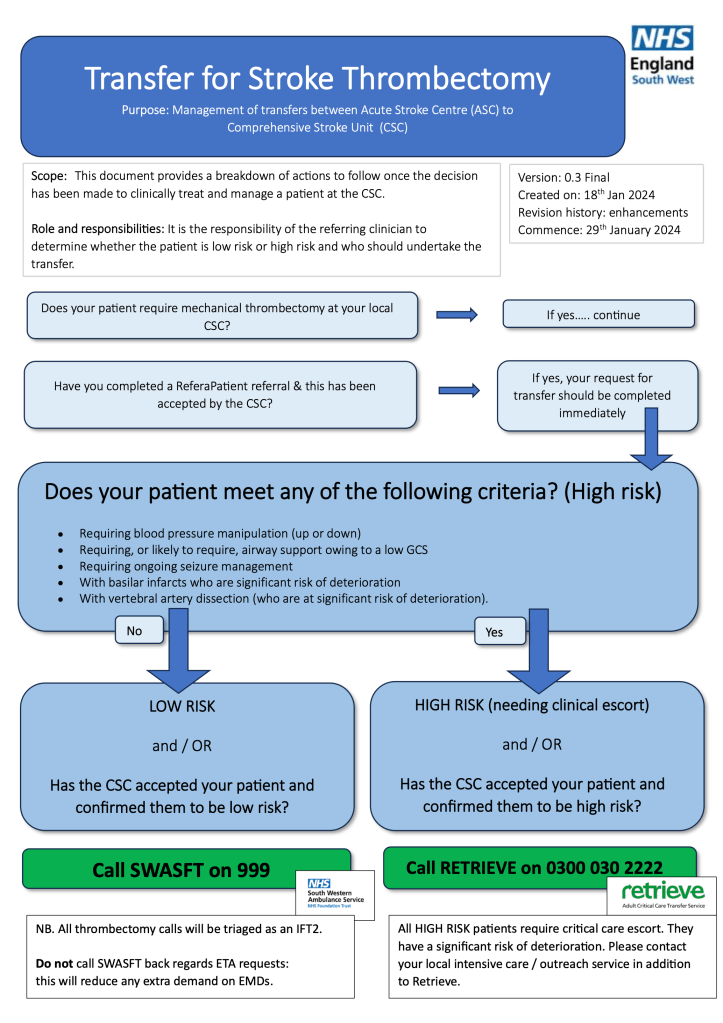
Around 15% of MT patients require a critical care transfer as they are high risk. These include patients:
- Requiring blood pressure manipulation (up or down)
- Requiring, or likely to require, airway support owing to a low GCS
- Requiring ongoing seizure management
- With basilar infarcts who are significant risk of deterioration
- With vertebral artery dissection (who are at significant risk of deterioration).
Note that basilar infarcts and vertebral artery dissection patients (who are at significant risk of deterioration) may not be widely recognised as requiring a critical care escort by referring hospital critical care and anaesthesia staff.
From December 2021 to January 2024, Retrieve piloted a process of triaging and coordinating all MT calls regardless of risk stratification. Following extensive feedback, review and stakeholder engagement, this process was changed in January 2024 to place the onus on the referring clinician to risk stratify the patient and then contact Retrieve for high risk patients and SWASFT, via 999, for low risk patients. This is summarised in the ISDN poster that has been circulated to all hospitals in the West of England and South West Peninsula ISDNs.
 Retrieve