
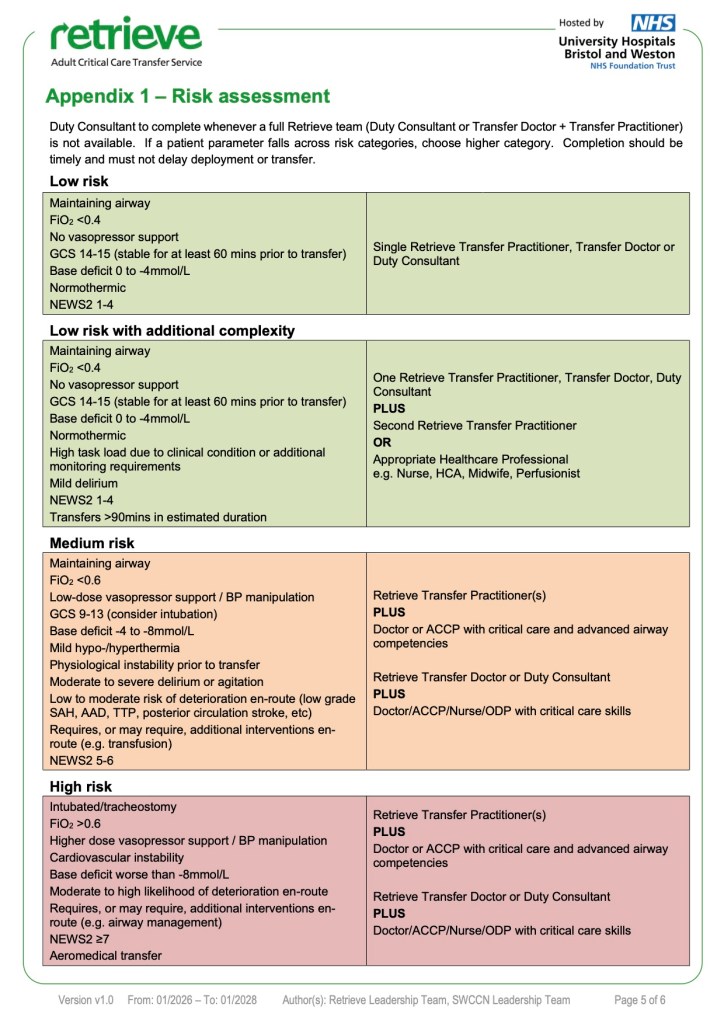
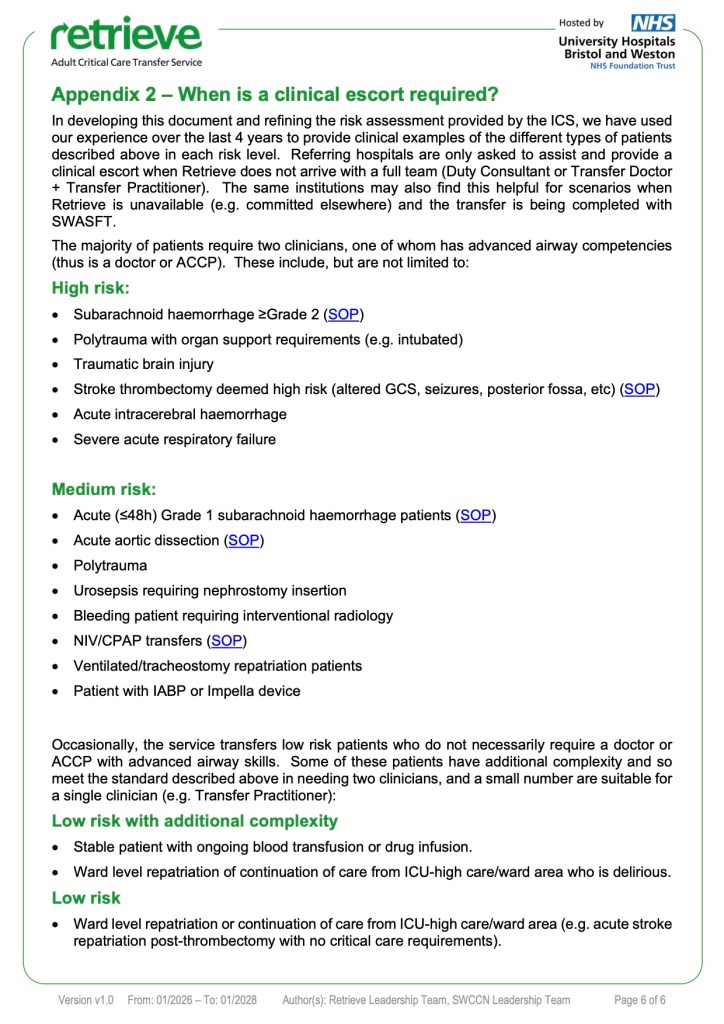
In circumstances where Retrieve is not fully staffed (with a doctor and Transfer Practitioner), we often need to ask for a clinical escort from your hospital to accompany the patient. This risk assessment guides when this occurs and will be used by our Duty Consultants during the referral and following initial patient assessment.
Key points
- The risk assessment is based on the Guidelines for the Provision of Intensive Care Services (GPICS) version 3 and the Intensive Care Society’s Guidance on: transfer of the critically ill adult.
- We will apply it transparently and consistently in the referral call and additionally following Transfer Practitioner assessment at the bedside, if the patient’s status has changed.
- For medium and high risk patients, an appropriate escort is a doctor or ACCP with critical care and advanced airway competencies.
Differences of opinion
- Whilst differences of opinion are relatively common, we expect the majority to be successfully resolved with respectful and pragmatic discussions involving referring hospital clinician(s) and Retrieve. We encourage senior clinician involvement – you will always speak with a Retrieve Duty Consultant.
- Where the outcome of the risk assessment is that the patient is moderate or high risk (requiring a doctor or ACCP with critical care and advanced airway competencies) and the referring hospital clinician disagrees and will not provide an escort we will:
- Not deploy if this is apparent in the initial referral call.
- Stand down and return to base if this arises at the beside.
- In these situations, Retrieve will not arrange a 999 ambualnce – the referring clinician will have to do so as they, and your Trust, will be taking on the risk associated with their decision.
If you have questions about this, or any other aspect of Retrieve, please get in touch.
 Retrieve